
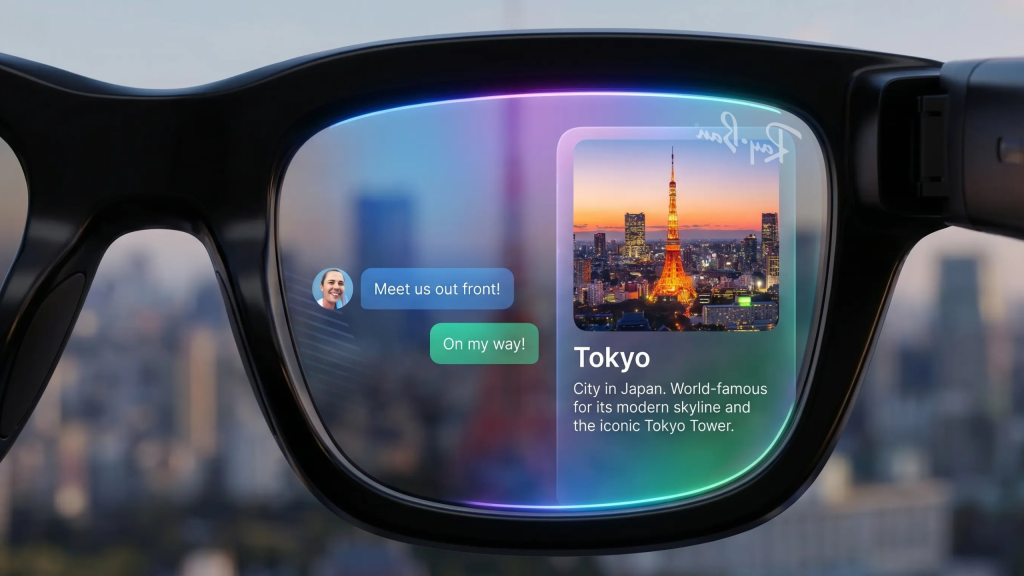
The real split is not Apple vs everyone else.
The buzz around Apple is understandable. Reuters reported in 2025 that Apple was planning smart glasses as part of its AI push, and a later Reuters report said Apple had halted a Vision Pro overhaul to focus on AI glasses that would rely heavily on voice interaction and artificial intelligence. At the same time, Apple executives are still publicly describing the blending of the digital and physical worlds as “inevitable,” suggesting Apple has not abandoned spatial computing as a long-term goal; it simply appears to be prioritizing a more practical first step.
That means the market is not really dividing into Apple equals AI and everyone else equals AR. The sharper reading is this: Apple looks like the clearest near-term AI-first player, Snap remains the clearest AR-first player, and Meta and Google are deliberately straddling both worlds.
Where the tech giants are focused right now
Apple: AI-first smart glasses, AR later
Apple’s rumored glasses strategy looks more like Meta’s early Ray-Ban model than a holographic headset. Reporting around Apple’s roadmap points to glasses centered on voice, cameras, Siri, and AI assistance rather than full AR overlays. Recent reports have even suggested Apple is testing multiple frame designs, reinforcing the idea that wearability and mainstream appeal matter as much as raw technical ambition. In other words, Apple seems to be asking: What can ship sooner, feel normal, and get worn every day?
Meta: shipping AI smart glasses now, building true AR in parallel
Meta is arguably the most aggressive company because it is pursuing all three layers at once. It now explicitly describes its lineup as three categories: camera AI glasses, display AI glasses, and augmented-reality glasses such as Orion. That matters because Meta is not betting on a single winner; it is commercializing AI glasses now while continuing to build toward consumer AR later. Its newer products add messaging, navigation, captions, translation, and AI-driven visuals, while Orion remains the long-term vision for holographic AR.
Meta also has the clearest proof of current demand. Reuters reported strong enough U.S. demand for Meta Ray-Ban Display that Meta paused international expansion, and EssilorLuxottica has said smart glasses are materially boosting growth. That does not yet prove mass adoption, but it does show that AI-enabled eyewear has moved beyond concept status.
Google: a two-lane strategy built around Gemini
Google’s strategy may be the most explicit. The company says it is building two types of glasses: screen-free AI glasses for speaking naturally with Gemini, taking photos, and getting help, and display AI glasses that add private in-lens information such as navigation and translation captions. Google has also emphasized fashion partnerships with Gentle Monster, Warby Parker, and, more recently, Kering, whose CEO told Reuters that Gucci-branded Google smart glasses are targeted for 2027. Google is effectively saying that AI is the entry point, while lightweight display experiences can scale on top of it.
Snap: still the boldest AR believer
Snap remains the clearest example of a company still framing glasses as a true AR computing platform. Its upcoming Specs are described as standalone, see-through glasses that integrate digital experiences into the physical world, and Snap says it has spent more than a decade and over $3 billion pursuing that vision. That is a much more immersive thesis than Apple’s rumored AI-assistant route.
What people actually want from smart glasses
The strongest signal from the market is that consumers appear more interested in useful, wearable AI than in ambitious AR for its own sake. S&P Global found that 48.2% of surveyed non-owners said they were interested in buying smart glasses within the next year. But the features being highlighted across the industry are revealing: translation, directions, messaging, photos, reminders, summaries, and contextual help. These are assistant jobs, not sci-fi hologram fantasies.
Just as important, companies are signaling what users care about by how they design the products. Google keeps talking about glasses people will want to wear all day. Meta is pushing prescription-ready frames, better comfort, and more optical-first designs. Reuters has also reported that privacy, comfort, and price remain major barriers to broader adoption. The subtext is obvious: people do not want a face computer that feels awkward, expensive, or socially threatening.
Privacy may be the biggest brake on the category. Reuters has reported European scrutiny around recording indicators, and WIRED recently reported that more than 70 civil-society organizations warned Meta against deploying facial recognition on smart glasses. So even when consumers like the convenience, trust remains fragile.
So which matters more right now: XR/AR or AI?
Right now, AI matters more. Not because AR is less important in the long run, but because AI delivers immediate value in a product people can already imagine wearing every day. Translation, notifications, memory aids, navigation, and voice assistance fit naturally into lightweight glasses. Full AR still looks like the endgame, but it remains harder, pricier, and less socially invisible. Meta, Google, and Snap still believe AR matters deeply; Apple’s rumored stance suggests it thinks the market must be won first with something simpler.
The smartest forecast is this: AI glasses will likely become the first mainstream category, and AR glasses will emerge later as the premium, more immersive layer. In that framework, Apple may not be behind the trend at all. It may be betting that the shortest path to winning glasses is not building the most futuristic product, but building the first one ordinary people actually want to wear.